A butterfly does not simply grow larger until it has wings. Its body is rebuilt through complete metamorphosis, a four-stage process that moves from egg to larva, then pupa, and finally adult. Each stage has a different job: the egg protects early development, the caterpillar eats and grows, the chrysalis reorganizes the body, and the adult reproduces and spreads to new places. Understanding these butterfly development stages makes one of nature’s most dramatic transformations much easier to follow.
The four stages of the butterfly life cycle
Butterflies belong to the insect order Lepidoptera, along with moths. Like many other insects, they undergo complete metamorphosis. That means the immature form looks and behaves very differently from the adult. There is no miniature winged butterfly hiding inside a caterpillar. Instead, tissues are reorganized during the pupal stage to produce the adult body plan.
Egg: the beginning of a new generation
The life cycle begins when a female butterfly lays an egg, usually on or near a plant that the newly hatched caterpillar can eat. This choice matters because caterpillars are often selective feeders. Monarch butterflies, for example, lay their eggs on milkweed because monarch larvae depend on milkweed leaves for food.
Butterfly eggs vary in shape, color, and surface texture. Some are round, while others are dome-shaped or ribbed. Inside, the embryo develops until a tiny larva is ready to emerge. In warm conditions, eggs of many common species hatch within several days, but timing differs with species, temperature, and season.
Caterpillar: the main growth stage
After hatching, the butterfly enters its larval stage and is called a caterpillar. This is the eating-and-growing phase of butterfly metamorphosis. A caterpillar spends much of its time feeding, storing energy, and increasing its body mass.
Because its outer skin cannot stretch indefinitely, the caterpillar molts several times. The period between molts is called an instar. With each new instar, the larva becomes larger until it reaches the size needed to pupate. The familiar caterpillar-to-butterfly story therefore includes several hidden steps before a chrysalis ever appears.
A practical way to observe this stage outdoors is to inspect the host plant rather than searching randomly for caterpillars. Look for fresh chewing damage, tiny droppings called frass, or eggs on the underside of leaves. Avoid handling larvae unnecessarily, and never remove them from a plant unless you know the species and its food requirements.
Pupa or chrysalis: transformation inside a protective case
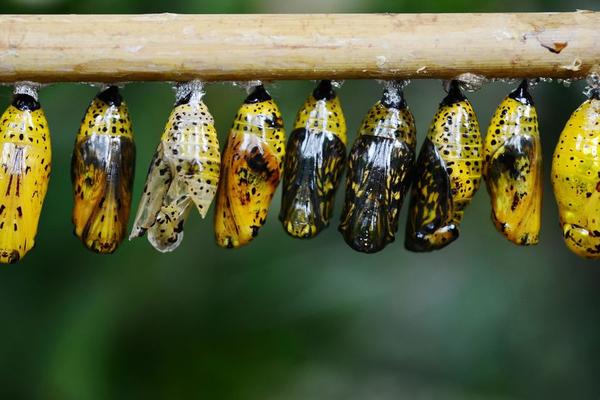
When the caterpillar finishes growing, it prepares to pupate. Butterfly pupae are commonly called chrysalises. The larva usually attaches itself to a sheltered surface, sheds its final larval skin, and reveals the chrysalis underneath.
The chrysalis stage can look inactive from the outside, but major biological changes are happening inside. Larval tissues are broken down and reorganized while adult structures develop, including wings, compound eyes, reproductive organs, and the adult feeding apparatus. Some structures begin forming before pupation, so the process is more organized than the idea of a caterpillar simply “dissolving” and starting again.
The duration of the chrysalis stage varies widely. In favorable summer conditions, some species emerge after roughly one or two weeks. Others remain pupae much longer, especially when development pauses through cold or dry seasons. This seasonal delay, called diapause in many insects, is one reason there is no single fixed timetable for every butterfly life cycle.
Adult butterfly: emergence, feeding, and reproduction
When development is complete, the adult splits the chrysalis and emerges. At first, its wings are soft, folded, and not ready for flight. The butterfly pumps fluid through the wing veins, allowing the wings to expand. It then waits while they harden and dry.
The adult stage is less about body growth and more about survival and reproduction. Adults may feed on flower nectar, tree sap, rotting fruit, or other liquid sources, depending on the species. They search for mates, and females locate suitable host plants on which to lay the next generation of eggs.
How long does the butterfly life cycle take?
There is no universal number of days. For many butterflies developing in warm, favorable weather, the journey from egg to adult may take several weeks. Temperature, food quality, species, day length, and seasonal dormancy can all change the schedule. A fast-developing summer generation may complete the immature stages quickly, while another generation of the same or a different species may pause for months.
For a familiar example, monarch development from egg to adult often takes around a month in warm conditions, though individual stages and total timing vary. The egg may last only a few days, the caterpillar stage roughly two weeks, and the chrysalis around another week or two. These figures are useful as a guide, not a rule for all butterflies.
Why each stage looks so different
The four-stage system reduces competition between young and adults. Caterpillars are built to consume solid plant material and grow quickly, while adult butterflies are built for flight, dispersal, mating, and finding new host plants. Because the two forms use the environment differently, they can occupy separate ecological roles even though they are the same animal at different ages.
This also explains why protecting butterflies requires more than planting flowers. Nectar plants help adults, but breeding populations also need the correct host plants for caterpillars. A garden with both food sources supports more of the complete life cycle than flowers alone.
Useful related topics
Readers who want to explore the subject further may also find these internal topics useful: butterfly host plants, how caterpillars grow and molt, and the difference between butterflies and moths.
Frequently asked questions
Is a chrysalis the same as a cocoon?
Not exactly. A chrysalis is the pupa of a butterfly. A cocoon is a protective silk covering made by the larvae of many moth species around the pupa. People often use the terms interchangeably, but biologically they describe different structures.
Does a caterpillar turn directly into a butterfly?
No. The caterpillar first becomes a pupa inside a chrysalis. The adult butterfly develops during this pupal stage and emerges only after metamorphosis is complete.
How many times does a caterpillar molt?
The number varies by species, but many butterfly caterpillars pass through several instars before pupating. Each molt allows the growing larva to replace an outer skin that has become too small.
Can butterflies survive winter?
Yes, but the overwintering stage depends on the species. Some survive winter as eggs, caterpillars, pupae, or adults, while migratory species may move to warmer regions instead.
From egg to winged adult
The butterfly life cycle is a sequence of specialized stages rather than a simple path of continuous growth. The egg begins development, the caterpillar gathers energy and grows, the chrysalis provides the setting for major body reorganization, and the adult carries the cycle forward through mating and egg-laying. Once you know what each stage is designed to accomplish, butterfly metamorphosis becomes less mysterious and even more remarkable.