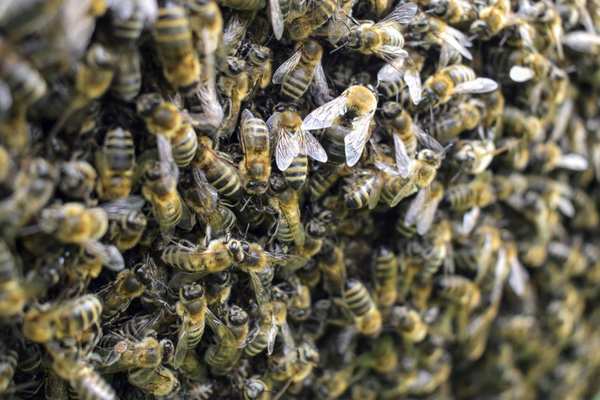
A honey bee colony can contain tens of thousands of individuals, yet it has no foreman assigning jobs or map pinned to a wall. Instead, bees coordinate through movement, scent, touch and vibration. Some signals point nestmates toward food, others announce danger, reveal the queen’s presence or encourage workers to become more active. The result is a colony that behaves with remarkable coordination even though each bee responds mainly to local information.
Colony communication is a network, not a single language
When people ask how bees communicate, the famous dance usually comes first. But the dance is only one channel. Inside a dark hive, visual information is limited, so bees combine body movements with chemical and mechanical cues. A returning forager may dance, carry a flower’s scent, offer nectar to nestmates and create vibrations on the comb. Together, those bee signals provide a richer message than any one cue alone.
Information spreads through repeated local interactions, allowing the colony to adjust as food, weather, threats and internal needs change.
The bee waggle dance turns movement into directions
The best-known example is the bee waggle dance performed by successful honey bee foragers. On a vertical comb, a dancer makes a straight “waggle run,” vibrating her body as she moves, then loops back and repeats the sequence. The angle of the waggle run relative to vertical corresponds to the direction of the food source relative to the sun. The duration of the waggle portion is related to distance: longer waggle runs generally indicate a farther destination.
Followers read more than an angle
Bees following the dancer stay close, often touching her with their antennae and detecting movement and vibration in the crowded hive. Once they leave, they do not simply fly a mathematically perfect line to a flower. They use the directional information as a guide, then rely on landmarks, floral odours and their own sensory abilities to locate the rewarding patch.
The dance is best understood as recruitment information rather than a complete set of coordinates. It points nestmates toward a worthwhile area, while the odour carried by the returning bee can help recruits identify the right type of flower.
Bee pheromones carry messages through scent
Chemical communication is just as important as movement. Bee pheromones are chemicals produced by one individual that influence the behaviour or physiology of others of the same species. Because scent can spread between bees and across hive surfaces, pheromones are especially useful in a dense social colony.
The queen’s scent helps organise colony life
A honey bee queen produces a blend of chemicals often discussed as queen pheromone. Workers near her detect these chemicals directly, and contact among workers helps distribute queen-associated cues through the colony. These signals contribute to social organisation and indicate that a functioning queen is present. They do not operate alone; workers also respond to brood, nutrition, season and other colony conditions.
Alarm pheromones recruit defenders
When a worker stings or becomes highly defensive, alarm chemicals can alert nearby bees and increase defensive behaviour. This is one reason disturbing a hive can produce a rapidly escalating response. The scent marks a place or threat as worth investigating, while visual and mechanical cues help defenders focus on what is happening.
Orientation scents help bees gather in the right place
Workers can release orientation pheromones from the Nasonov gland, often while raising the abdomen and fanning their wings. This can help nestmates orient to a hive entrance, swarm cluster or other important location. It is a clear example of movement and scent working together.
Touch and food exchange pass information at close range
Bees constantly make antennal contact as they move through the nest. These brief touches help them sample odours and respond to nearby activity. Food exchange, known as trophallaxis, adds another layer: one bee can pass liquid food to another mouth-to-mouth. Besides distributing nutrition, this contact exposes workers to food odours and colony chemicals, helping information circulate.
Useful related topics for deeper reading include bee life cycle, the roles of worker bees, and how bees find flowers.
Vibrations can activate or interrupt behaviour
Honey bees also communicate mechanically. The comb transmits vibrations, and bees can detect movement through sensory organs in their legs and antennae. One example is the shaking or dorso-ventral abdominal vibration signal, which is associated with increased activity in recipients. Rather than ordering a specific task, it works more like a general activation signal whose effect depends on the bee receiving it.
Another signal, commonly called the stop signal, can reduce recruitment by causing a waggle dancer to pause or stop dancing. This gives the colony a way to dampen enthusiasm for a food source or situation that has become risky or less useful. Communication therefore includes both encouragement and inhibition.
What communication looks like during a real foraging trip
Imagine a scout discovers a rich patch of flowers several hundred metres from the hive. She returns carrying the floral odour and nectar from that patch. On the comb, she performs repeated waggle runs. Interested workers follow closely, sensing her movement, touching her and sampling the nectar or scent. Recruits then fly in the indicated direction and search for the matching flowers. If the patch remains profitable, successful recruits return and may dance too, strengthening recruitment. If conditions deteriorate, recruitment can fade or be inhibited.
This shows why no single bee signal explains colony behaviour. Direction, odour, food quality, vibration and repeated feedback all contribute to the final response.
Do all bees communicate with a waggle dance?
No. The detailed waggle-dance system is associated with honey bees, and different bee species have different social structures and communication methods. Many bee species are solitary, so they do not need the same large-scale recruitment system used by a honey bee colony. Even among social bees, the importance of scent, contact and movement varies.
Frequently asked questions
Can bees talk to each other?
Not with words, but they exchange meaningful information through movement, pheromones, touch, food exchange and vibrations. These signals can affect where other bees travel, how active they become and how the colony responds to danger.
How does a bee tell others where flowers are?
A successful honey bee forager can use the waggle dance to communicate the general direction and distance of a rewarding food source. Recruits also use floral scent, landmarks and their own navigation senses to find the exact patch.
Can bees communicate in the dark?
Yes. Much colony communication happens inside a dim hive, where scent, antennal contact and vibrations are highly useful. Waggle-dance followers also detect close-range mechanical cues rather than relying only on vision.
What pheromone warns bees of danger?
Honey bee workers release alarm pheromones during defensive situations. These chemicals increase alertness and help recruit or focus nearby defenders, especially when combined with other cues from the disturbance.
A colony built on overlapping signals
Bee communication works because several channels overlap. The waggle dance can point workers toward food, pheromones can signal identity, danger and location, close contact spreads odours and food information, and vibrations can raise or suppress activity. Together these systems allow thousands of bees to make fast, decentralised decisions and keep the colony responsive to a changing world effectively.