A red, spotted beetle is easy to recognise. Its young are another story. Before a ladybird develops its rounded wings and familiar markings, it looks like a tiny, spiky crawler that many gardeners mistake for a pest. Understanding the ladybird life cycle makes those surprising changes easier to spot—and helps explain why these insects are useful visitors to plants.
Ladybirds are beetles, not true bugs. Like butterflies, they undergo complete metamorphosis, passing through four distinct stages: egg, larva, pupa and adult. Each stage has a different job, from feeding and growth to reproduction and surviving colder weather.
The four stages of the ladybird life cycle
Although the timetable varies by species, temperature and food availability, the sequence stays the same. Eggs hatch into active larvae. Larvae eat and moult as they grow. A pupa transforms into an adult beetle, which eventually mates and produces the next generation.
1. Egg: a small beginning near a food supply
In spring and summer, a female ladybird typically places clusters of small, upright eggs on leaves or stems. In many familiar species, the eggs are yellow or orange and often appear close to colonies of aphids. That location matters: newly hatched larvae need food almost immediately, and aphids are a major prey item for many species.
Eggs are easily overlooked, especially on the undersides of leaves. Their hatching time depends on warmth and species, so a fixed number of days is not reliable for every ladybird. If you find a cluster, observe it without moving the leaf; even a gentle disturbance can damage eggs.
2. Larva: the busy feeding and growing stage
Ladybird larvae look nothing like miniature adults. They have elongated bodies, six legs and, depending on the species, dark colouring with orange markings, hairs or short spines. The young of a seven-spot ladybird and a harlequin ladybird can look different, so spikes alone do not identify the species.
For many predatory ladybirds, this is the stage of relentless hunting. Larvae move around leaves and stems, consuming aphids and sometimes other small insects. They do not simply stretch into larger bodies. Their outer skeleton is rigid, so they must shed it repeatedly. Each period between moults is called an instar; familiar ladybird species commonly pass through four larval instars before pupating.
A larva that becomes still may be preparing to moult rather than dying. Leave it undisturbed, especially if it has attached itself to a plant. To learn why gardeners value these hungry youngsters, see our guide to insects that eat aphids.
3. Pupa: transformation while attached to a surface
Once the larva has finished feeding and growing, it attaches itself to a leaf, stem or other support. It may first enter a short, relatively motionless pre-pupal period. Then it becomes a pupa, often appearing as a compact shape with dark, orange or contrasting markings.
Ladybird pupae do not hunt or travel around the plant. Inside the pupal covering, the insect undergoes a major reorganisation: the elongated larval form gives way to an adult body with wing cases, wings and reproductive organs. This dramatic change is the defining feature of ladybird metamorphosis.
A pupa may look dried out or lifeless, but appearance alone is misleading. Avoid peeling it from the leaf or opening its covering. If the plant needs attention, work around the attached pupa until the adult emerges.
4. Adult: wings, reproduction and survival
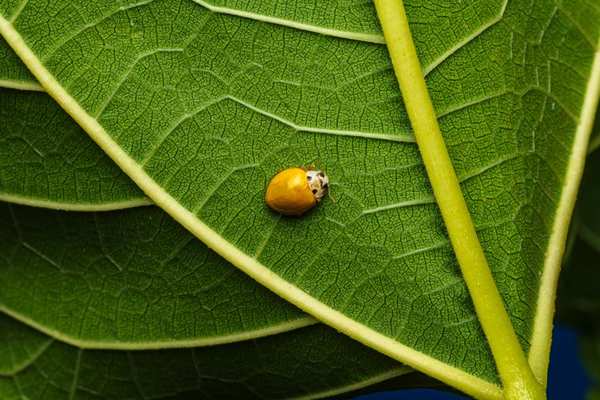
The newly emerged adult may be pale, soft and almost spotless. Its wing cases gradually harden, and the colours and markings become clearer. A pale ladybird is not necessarily a different species. Once mature, adults can feed, disperse, mate and lay eggs, starting another cycle.
The visible spotted covers are hardened forewings, called elytra. Delicate flying wings fold beneath them. Spot counts and colours differ between species; they do not tell you how old an individual ladybird is. For a closer look at markings, explore common UK ladybirds and how to identify them.
How long does ladybird development take?
There is no universal stopwatch for the ladybird development stages. In warm conditions with plentiful prey, some species can progress from egg to adult in roughly a month. Cooler weather, scarce food and differences between species can extend development. The larval stage often takes a substantial share of that period because the insect must gather enough resources for its transformation.
Development time is different from lifespan. Becoming an adult does not mean the life cycle is over: many adult ladybirds live for months, and those surviving winter may reproduce the following spring. Depending on conditions and species, a population may produce more than one generation in a year.
What changes through the seasons?
In Britain, many familiar ladybirds spend winter as adults in sheltered places such as leaf litter, bark crevices, hollow stems or sheds. They become active again as temperatures rise, searching for food and mates. Eggs and larvae are consequently easier to find during the warmer growing season, although exact dates shift with weather and species.
Some ladybirds gather in groups while overwintering, especially harlequins. A cluster indoors is not evidence that the insects are breeding there. They may simply be using the building as shelter. If needed, gently relocate them to a suitable sheltered outdoor spot rather than spraying them.
How to observe the stages in your garden
An aphid-covered rose or bean plant can be a good place to watch this process. Examine the undersides of leaves for egg clusters, then check nearby shoots every few days for active larvae. Photograph what you see from the same distance; the sequence is easier to understand when you compare changes over time.
Do not assume every ladybird species eats aphids. Some feed on scale insects, while others eat mildew or plant material. Identifying both the insect and its host plant gives a more accurate picture. Avoid pesticides and unnecessary handling while observing. A guide to encouraging beneficial insects in gardens can help you make a welcoming habitat.
Frequently asked questions
Do baby ladybirds have spots?
No. A newly hatched ladybird is a larva, not a tiny round beetle. Larvae usually have elongated bodies and may show coloured patches or spines. The familiar adult wing-case pattern develops later, after pupation.
Do ladybirds make cocoons?
No. Ladybird pupae are generally attached directly to a surface rather than enclosed in a spun silk cocoon. The pupal stage is still a period of complete internal transformation.
What do ladybird larvae eat?
Many species feed chiefly on aphids and other small insects, but diets vary. Some ladybirds specialise in scale insects or fungi. Matching a larva to its species helps explain what it is eating.
Can ladybirds reproduce more than once a year?
Yes. Some species have multiple generations in favourable seasons. Others reproduce less often, depending on local climate, food supply and their particular biology.
Conclusion
From a tiny egg to a voracious larva, an apparently motionless pupa and finally a flying adult, the ladybird life cycle is a remarkable example of complete metamorphosis. Protect the unfamiliar stages as carefully as the colourful adults. That odd-looking crawler or attached pupa may soon become your next ladybird.