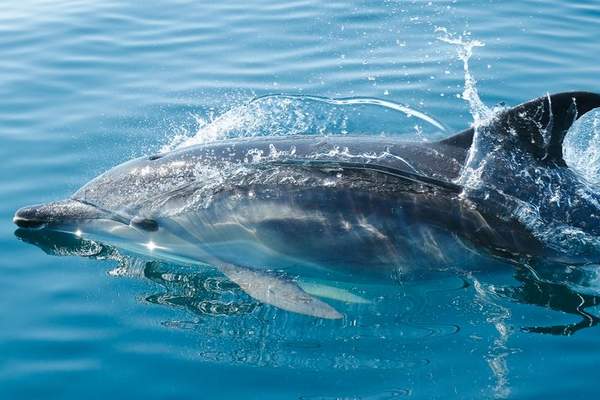
A dark fin breaking the surface off a Welsh harbour or a quick leap beyond a Scottish headland can be a dolphin encounter, not a sight reserved for warmer seas. Dolphins in UK waters are varied: some live in recognisable coastal communities, while others travel through deeper offshore habitats. Knowing which species to expect, and why they appear in particular places, makes sightings more meaningful.
Which dolphin species live around Britain?
Several species occur regularly or seasonally in British seas. The most recognisable UK dolphin species differ in body shape, colouring and habitat, so location alone is not enough for identification.
Bottlenose dolphin
Powerfully built, mostly grey and equipped with a distinct beak, bottlenose dolphins are among the easiest British dolphins to recognise. They can exceed three metres in length. Semi-resident communities use Cardigan Bay in west Wales and the Moray Firth in north-east Scotland, although individuals travel beyond these areas. They hunt fish in bays, estuaries and open water, often surfacing in small groups.
Short-beaked common dolphin
Despite the name, common dolphins are not equally common at every UK beach. They are especially associated with western and south-western waters, where groups may be seen feeding or bow-riding. Look for a slender body, pointed beak and distinctive yellowish and grey hourglass pattern along the sides. Groups can be large where prey is concentrated.
White-beaked dolphin
This stockier, cold-water species is associated with the northern North Sea and waters around Scotland. It has a relatively short, often pale beak, a tall curved dorsal fin and contrasting light markings. Appearance varies between individuals, so a glimpse of white water is not sufficient for identification.
Risso’s dolphin
Risso’s dolphins look unlike the classic long-beaked silhouette. They have a rounded head without an obvious beak and often carry pale scratches across their grey bodies, sometimes becoming strikingly light with age. They are recorded around western Scotland, the Hebrides and parts of the Irish Sea, including waters near Anglesey.
Other dolphins and close relatives
Atlantic white-sided dolphins occur mainly in cooler northern and offshore waters. Striped dolphins are recorded too, particularly offshore, but are less likely to feature in an ordinary coastal watch. Killer whales, or orcas, belong to the dolphin family, although most people discuss them separately because of their size and hunting ecology. Harbour porpoises are another frequent sighting, but they are porpoises rather than dolphins.
Where are dolphins most likely to be seen?
Cardigan Bay, particularly around New Quay, is known for bottlenose dolphin observations. The Moray Firth has another established coastal population, with shore-watching opportunities around its coast. Both areas support dolphins year-round, although an encounter is never guaranteed.
Elsewhere, dolphins around Britain are reported off Cornwall, the Isles of Scilly, western Wales and the Scottish west coast. White-beaked dolphins are more characteristic of northern waters, while common dolphins may appear off the south-west and along western offshore routes. A headland overlooking a tidal channel can be more promising than a beach with restricted visibility.
What makes a good dolphin habitat?
Dolphin distribution follows food, water conditions and seafloor geography rather than county boundaries. Fish-rich bays attract coastal bottlenose dolphins, while fronts, tidal races and continental-shelf edges can concentrate prey for wide-ranging species. Some animals move seasonally; others return repeatedly to familiar feeding areas.
Diet varies. Bottlenose dolphins take fish and sometimes cephalopods. Common dolphins hunt schooling fish and squid. Risso’s dolphins are particularly associated with squid and other cephalopods. A pod circling, diving repeatedly and surfacing near diving seabirds may be feeding rather than travelling past.
How to read dolphin behaviour from the coast
A dolphin’s movement offers clues, but no single splash has one fixed meaning. Repeated directional surfacing may indicate travel. Rapid changes of direction, tight grouping and diving seabirds can suggest feeding. Leaps and body rolls also occur during social activity, communication or movement; they should not automatically be called play.
Bow-riding is familiar to boat passengers: dolphins sometimes use the pressure wave ahead of a moving vessel. It is their choice, not an invitation for a boat to chase them. Calves generally stay near adults, and steering through a group can cause disturbance.
A guide to dolphin communication and echolocation offers more context for their clicks and whistles, which observers cannot ordinarily hear from shore.
How to identify a dolphin during a brief sighting
Start with the overall profile, not just the fin. A robust grey dolphin with a clear beak near Cardigan Bay might be a bottlenose; a slimmer animal with yellowish flank markings off Cornwall suggests a common dolphin. A blunt-headed, heavily scarred animal warrants a closer look for Risso’s dolphin. These are clues, not proof.
Record the date, location, approximate group size, sea conditions and behaviour. A photograph showing the head, flank and fin is more useful than an indistinct splash. Compare your observations with a UK cetacean identification guide or a guide to dolphins versus porpoises before reporting a species with confidence.
Watching dolphins without disturbing them
Shore watching with binoculars is an excellent way to observe coastal cetaceans. Choose a sheltered viewpoint, scan slowly across the sea and look for repeated dark shapes surfacing. Calm conditions make small fins easier to detect, although dolphins can appear at any hour.
On vessels in English waters, government wildlife guidance advises keeping at least 100 metres from marine animals, travelling below six knots nearby and never pursuing or feeding them. If dolphins approach your boat, maintain a predictable course and let them leave freely. Check local guidance elsewhere in the UK, and give animals more space if their behaviour changes.
Frequently asked questions
Are dolphins native to UK waters?
Yes. Several species naturally inhabit or regularly visit UK seas. Bottlenose dolphins have well-studied coastal communities, while others range across broad offshore areas.
What is the most common dolphin near the British coast?
There is no single answer for every coastline. Bottlenose dolphins are prominent in certain hotspots, common dolphins are widespread in western waters, and white-beaked dolphins are characteristic of cooler northern areas.
Can you see dolphins in the UK during winter?
Yes. Some bottlenose communities remain in British waters year-round. Sightings and viewing conditions vary with location, weather and prey movements, so winter offers no guaranteed encounter.
How can I report a dolphin sighting?
Submit observations to a recognised scheme such as the Sea Watch Foundation sightings network. Include location, time, number of animals, identification clues and photographs if available. An uncertain sighting can still be useful when labelled honestly.
A coastline shared with dolphins
UK seas support far more dolphin diversity than a fleeting dorsal fin might suggest. Ask not only which species you saw, but what brought it there, how it behaved and how to watch without interference. With patience and careful observation, an ordinary coastal walk can contribute to understanding Britain’s marine wildlife.