Choosing a family dog is less about finding the breed with the friendliest reputation and more about matching a dog’s everyday needs to the way your household actually lives. A breed that thrives with long daily walks can feel effortless in an outdoorsy family and overwhelming in a busy home. Grooming, training, size, energy and the ages of your children matter just as much as appearance.
The best family dog breeds in the UK therefore vary from home to home. Breed traits are a useful starting point, but individual dogs still differ, and socialisation, training, health and previous experiences all influence behaviour. The better question is: which dog can your family realistically keep happy for the next decade or more?
What makes a dog a good fit for family life?
Start with your normal routine. Consider how much exercise adults can provide, whether someone is usually at home, how much grooming you will do, the space available and how calmly your children can interact with a dog. Young children should always be closely supervised around dogs, and every dog needs a quiet place to rest undisturbed.
It also helps to separate “calm” from “low exercise”. Some calm family dog breeds are relaxed indoors because their physical and mental needs have been met. An under-stimulated dog of almost any breed can become restless or destructive.
Family-friendly dog breeds worth comparing
Labrador Retriever
Labradors are strong all-round candidates for active families. They are affectionate, sociable and usually respond well to reward-based training, while their short coats are relatively straightforward to maintain. Their main trade-off is energy: they need meaningful daily exercise and mental enrichment rather than a quick walk around the block.
They are also large, enthusiastic dogs, so excited play can be boisterous around small children. Families considering a puppy should ask about health screening relevant to the breed, including hip and elbow problems.
Golden Retriever
Golden Retrievers are often excellent dogs for children because they tend to be affectionate, trainable and tolerant when well socialised. They suit households wanting a large dog to join family activities and that have enough time for exercise, play and training. PDSA advises around two hours of daily exercise.
The practical trade-off is grooming. Golden Retrievers shed heavily and need frequent brushing, so they suit families who do not mind dog hair and can commit to coat care.
Cocker Spaniel
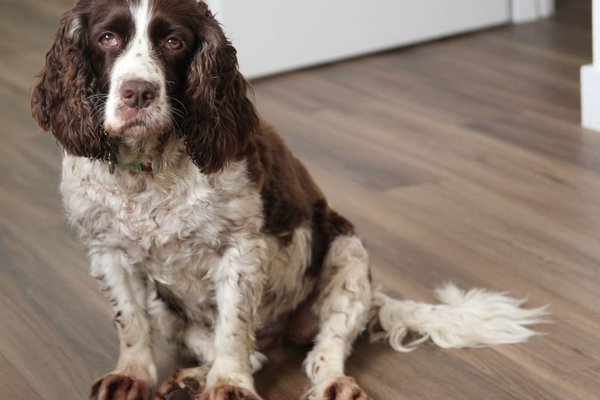
A Cocker Spaniel offers much of the cheerful, people-oriented character associated with gundogs in a more compact body. Well-socialised Cockers commonly get along with children and can be engaging family companions. They are lively dogs, however, and need daily exercise, play, training and opportunities to sniff and explore.
The feathered coat also needs more attention than a short coat. This can be a good option for a family wanting a medium-sized dog with energy for outings, provided excitable play is managed calmly around younger children.
Poodle
Poodles are intelligent, trainable and often good with children when properly socialised. They can work especially well for families who enjoy teaching tricks, games and new behaviours. Their coats are sometimes described as low shedding, but that does not mean low maintenance: Poodles need frequent grooming and periodic professional clipping.
Poodles come in different sizes, so compare the needs of the particular variety rather than treating every Poodle as the same.
Whippet
For households interested in calm family dog breeds, the Whippet deserves a closer look. Whippets are typically gentle and can be notably relaxed indoors after exercise. Their short coats are easy to maintain, and their medium size suits many homes. PDSA recommends at least about an hour of daily exercise, including safe opportunities to run.
The trade-off is sensitivity and prey drive. Secure areas are important for off-lead running, and some Whippets may suit slightly older children who understand when a dog wants space.
Border Terrier
Border Terriers are small but energetic. They can be friendly family dogs and often enjoy being involved in household life, yet they need far more activity than their size suggests. Around an hour of exercise a day, plus play and training, is a sensible expectation.
The wiry coat is fairly manageable, but terrier instincts can show up as digging, chasing and determined exploration. Secure gardens and consistent training matter, making them better for families wanting a compact, active dog than a low-energy lap dog.
Which breed suits which kind of family?
A practical way to compare family friendly dogs in the UK is to begin with your least flexible constraint. Outdoorsy households may suit a Labrador or Golden Retriever. Families wanting a smaller active companion might prefer a Cocker Spaniel or Border Terrier. A Whippet may appeal if you want a quieter dog indoors after exercise, while a Poodle suits owners who enjoy training and can budget for grooming.
Try a real-world test before deciding: map out a normal Tuesday rather than an ideal Sunday. Who walks the dog before school? Who handles the evening walk in winter? Who pays for grooming? Where does the dog rest when children have friends over? This exercise often reveals a better match than a popularity list.
Training and supervision matter as much as breed
No breed label can guarantee that an individual dog will be safe or relaxed around children. Positive socialisation, consistent reward-based training and respectful handling are essential. Children should learn not to disturb a dog while it is eating or sleeping, not to take toys from its mouth, and to let it move away when it wants space.
If buying a puppy, ask for evidence of health tests appropriate to the breed and use a responsible breeder. Rehoming can also be an excellent route when a reputable rescue can describe an individual dog’s history, temperament and suitability for a home with children.
Frequently asked questions
What is the best family dog breed for young children?
There is no single best breed for every family. Labradors, Golden Retrievers and well-socialised Cocker Spaniels are commonly considered good companions, but size, energy, training and the individual dog’s temperament all matter. Close adult supervision is always necessary.
Which family dog needs the least grooming?
Among the breeds covered here, short-coated Labradors and Whippets are relatively straightforward to brush, although both still shed. Poodles may shed less visibly but require considerably more coat care and professional grooming.
Are small dogs automatically better for children?
No. Small dogs take up less space, but some are energetic, sensitive or easily overwhelmed by rough handling. A larger, well-trained dog may suit a calm family better than a small breed whose needs do not match the household.
Should a family choose a puppy or an adult dog?
A puppy requires intensive toilet training, socialisation and supervision. An adult rescue dog with a known history can sometimes be easier to assess for temperament and compatibility with children.
Choose for compatibility, not popularity
The best family dog is the one whose needs your household can meet consistently. Compare exercise, grooming, trainability, size and health considerations before deciding. When those practical factors line up, the chances of finding a happy long-term companion are far better than when a breed is chosen mainly for appearance or popularity.