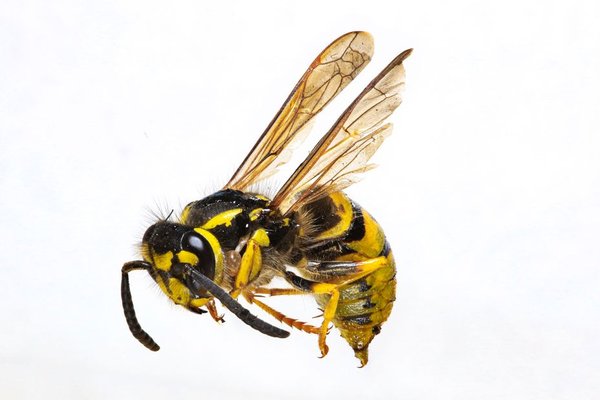
Spot a yellow-and-black insect at a picnic and you might call it a wasp without a second thought. Yet wasp species in the UK are far more varied than the familiar summer visitors. Some raise colonies in papery nests; others work alone, hunting flies or spiders for their young. The quickest route to identification is often to notice what an insect is doing, not just its colour.
Social wasps and solitary wasps: the difference
Social wasps live in colonies, usually founded by a queen in spring. Workers gather prey, enlarge the nest and defend it if disturbed. British colonies are generally annual: most individuals die as winter approaches, while new queens seek shelter.
Solitary wasps have no worker force or shared defensive colony. A female typically provisions her own nest cells with prey for her offspring. Several may nest near one another in sand or timber, but each female generally works independently. Most British wasps are not the familiar picnic visitors.
Social wasp species commonly seen in Britain
Common wasp (Vespula vulgaris)
Widespread in gardens and orchards, the common wasp has bold black-and-yellow markings and often an anchor-shaped dark mark on its face. Colonies may occupy underground cavities, wall voids or lofts. Repeated flights through one opening suggest an active nest.
German wasp (Vespula germanica)
The German wasp resembles the common wasp, but its facial mark often appears as three dark spots rather than an anchor. Both use sheltered cavities for papery nests. Markings vary, so a blurry view of the abdomen is rarely enough to distinguish them confidently.
Tree wasp (Dolichovespula sylvestris)
Tree wasps occur around woodland edges, hedges and gardens. Their nests may hang in vegetation or occupy sheltered spaces. They resemble other yellow-and-black social wasps, making head markings more helpful than nest location alone.
Red wasp and Saxon wasp
The red wasp (Vespula rufa) has reddish tones on its abdomen and often favours more natural habitats. The Saxon wasp (Dolichovespula saxonica) is another British social species, particularly familiar in the south. Neither should automatically be mistaken for a common wasp.
European hornet (Vespa crabro)
Britain’s native hornet is considerably larger than a typical worker wasp. Look for reddish-brown colouring on the head and thorax, with a yellow abdomen bearing dark marks. It nests in cavities, often in woodland or buildings. A hornet flying nearby is not necessarily behaving aggressively.
Solitary British wasps worth recognising
Field digger-wasp (Mellinus arvensis)
This slender black-and-yellow hunter is active mainly from late summer into autumn. Females dig burrows in sandy ground and supply nest cells with captured flies. A wasp repeatedly visiting a tiny hole on a heath, dune or sandy garden patch may be a digger-wasp.
Potter and mason wasps
Many potter wasps have narrow waists and yellowish markings. Females use mud to make or partition small nesting cells stocked with caterpillars or other larvae. A neatly formed mud chamber on a sheltered surface can reveal more than a fleeting glimpse of the adult.
Spider-hunting wasps
Spider wasps often run rapidly over bare ground and stones searching for prey. Some are dark with reddish markings. Anoplius viaticus, associated with sandy heathland, hunts spiders to feed its offspring. Seeing a wasp drag a spider is a valuable clue, though not proof of its species.
Wood-nesting digger wasps
Some Ectemnius species tunnel into dead wood and stock their nests with flies. Sunny stumps, rotting logs and old timber can therefore attract solitary wasps without containing a social colony. Retaining some sound dead wood benefits these insects.
UK wasp identification: what to look for
Start with three questions: Is there constant traffic through one entrance? Is the insect carrying prey? What habitat surrounds it? Warning colours occur across many groups, and even specialists sometimes need several viewing angles to separate social wasps.
Photograph the side, head and upper body if you can do so safely. Record approximate size, location, month and behaviour. Never block a nest entrance to obtain a picture. For lookalikes, consult a guide to wasps vs hoverflies; for nesting clues, see how to identify wasp nests.
Consider a garden shed: dozens of wasps passing through one gap beneath the roof suggest a social colony. A lone slender wasp bringing a fly to a sandy hole suggests solitary nesting. Behaviour provides a useful starting point before you have a name.
When and where are British wasps active?
Social queens become noticeable in spring, while worker numbers rise in summer. Encounters around sweet food often increase later in the season. Solitary flight periods differ: some spider wasps emerge early, while field digger-wasps are especially noticeable later in the year.
Woodland cavities, sandy soils and dead timber favour different nesters. Gardens also offer flowers for adult wasps and smaller insects as prey. A guide to common UK garden insects can help place these sightings in context.
Wasps, hoverflies and staying safe
Hoverflies mimic wasp colours but are flies, with one pair of wings instead of the two pairs found in wasps. Many hover in place and have short antennae. Wasps generally have more prominent antennae, though appearances overlap.
Social wasps may sting when trapped or when their nest is threatened. Solitary wasps rarely trouble people if left undisturbed. Cover outdoor food, move calmly and seek professional advice if a nest poses a real risk near a doorway. Avoid handling any unidentified nest.
Frequently asked questions
How many wasp species live in the UK?
The Natural History Museum describes more than 7,000 UK wasp species, including many tiny parasitoid wasps. Only a small minority form the familiar social colonies.
Are solitary wasps aggressive?
Usually not. Females concentrate on hunting and provisioning their own nests rather than defending a colony. Give them space and avoid handling them.
Is every large wasp a hornet?
No. Queens of other social wasps can also look large. Consider colour, proportions and several viewing angles rather than size alone.
What is the yellow-legged hornet?
The non-native yellow-legged hornet (Vespa velutina) has been recorded in the UK and is monitored because it preys on pollinators. Check official identification guidance and report credible sightings through the recognised UK service; never approach a suspected nest.
Look beyond the yellow stripes
British wasps help regulate insect populations and also visit flowers. Distinguishing social colonies from solitary nesters turns a vague sighting into a useful wildlife observation. Watch their flight paths, prey and nesting materials from a respectful distance, and you will see how much diversity shares an ordinary garden.