Look closely at a spider web and its shape often tells you how the spider hunts. A neat wheel between branches intercepts flying insects. A silken sheet across grass works like a landing platform. A ragged-looking tangle in a shed can be an effective trap rather than a failed attempt at weaving.
Different spider web types reflect different strategies for catching food, sensing movement and staying protected. Learning their shapes helps explain what a spider is doing, even when the spider itself is hidden.
Why Do Spiders Build Different Webs?
A web is more than a sticky net. It extends a spider’s sense of touch: vibrations travel through silk and reveal where prey has landed. Some designs target insects in flight; others catch creatures moving through vegetation or across the ground.
Not every spider makes a prey-catching web. Jumping spiders and many wolf spiders hunt actively, although they still produce silk for safety lines, retreats or egg sacs. Web shapes vary within categories, so consider both structure and location when identifying them.
Orb Webs: Circular Traps for Flying Insects
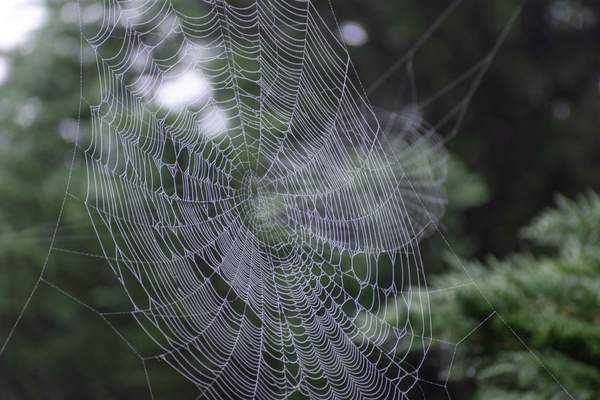
Orb webs are the familiar wheel-shaped structures between plants, fences and branches. Strong radial threads run outward like spokes, supporting a spiral of capture silk. In many orb webs, the spokes are not sticky while the finished catching spiral carries adhesive droplets.
This layout creates a broad interception area without filling every gap with silk. A fly or moth hitting the spiral may become trapped long enough for an orb-weaver to reach it. Some spiders sit at the centre; others wait in a retreat connected by a signal thread.
Many orb-weavers repair or replace damaged webs, and some consume old silk before spinning again. A nearly perfect circle sparkling with morning dew is probably an orb web.
Sheet Webs: Horizontal Platforms That Catch Falling Prey
Sheet webs form flat, curved or hammock-like surfaces, often low among grass, shrubs or branches. Some have a maze of lines above the sheet. An insect hitting those threads may drop onto the platform, where the spider rushes across to seize it.
Not all sheet webs use sticky silk; their arrangement and the spider’s speed also matter. Bowl-and-doily spiders make layered structures, including a bowl-shaped sheet. Such webs may be almost invisible until dew outlines their surface.
Funnel Webs: A Hunting Platform With an Escape Route
Funnel webs often combine a broad silk sheet with a narrowing tunnel at one edge. The spider waits at or inside the retreat, detecting vibrations from insects moving on the sheet. It can sprint out, capture prey and retreat when disturbed.
Grass spiders and various house spiders build webs of this general form. Their sheet is often dense and relatively non-sticky, relying on fast reactions rather than glue. Look for funnel webs in grass, low vegetation, corners or sheltered gaps around buildings.
A funnel-shaped web does not automatically identify a dangerous Australian funnel-web spider. That name also describes a particular group of spiders, and web appearance cannot reliably establish whether a spider is medically significant.
Tangle Webs and Cobweb Types: Irregular but Effective
Tangle webs, sometimes called cobwebs, look disorganised compared with orbs. Their three-dimensional networks cross between supports, creating a space where insects stumble into catching lines. Many cobweb spiders belong to the family Theridiidae.
Some species add sticky vertical threads anchored to the ground. When a walking insect catches one, its attachment can break, allowing the thread to lift or hold the prey. The spider approaches along supporting lines. This design suits sheltered corners where insects travel.
In everyday speech, cobweb also means an old, dusty or abandoned web. A dusty web is not necessarily a newly built tangle, and an irregular shape does not mean its spider has stopped using it.
Lace Webs: Fine Fibres Instead of Sticky Droplets
Lace webs can look woolly or densely woven around cracks, bark and crevices. Some spiders use cribellate silk, composed of extremely fine fibres that snag insect legs and bristles without the glue droplets found on many orb webs.
One web traps prey with adhesive; another entangles it through a mass of tiny fibres. Both approaches give the spider time to react.
Radial, Tube and Purse Webs: Silk Built Around Shelter
Radial and Tube Webs
Some tube-dwelling spiders line a hole with silk and extend threads outward. These radiating lines act as alarms when an insect crosses them. Instead of waiting in an exposed net, the spider launches from its hidden tube toward passing prey.
Purse Webs
Purseweb spiders build tough silk tubes, often partly underground and partly extending along a surface. The exposed section may be disguised with soil or debris. When an insect walks over it, the spider can strike from inside, using its shelter as part of the ambush.
Not every web is an open net. Sometimes silk’s main job is providing a safe hunting position.
How Spiders Make Webs That Work
Spider silk consists of proteins produced inside the body and drawn out through spinnerets near the abdomen’s rear. Spiders can make silk with different properties for supporting lines, catching threads and retreats. They anchor strands, stretch frameworks into place and add finer material where needed.
Location matters as much as design. An orb web across an insect flight path may collect prey quickly, while a sheet near ground vegetation intercepts different movement. Rebuilding or adjusting a web helps spiders respond to changing conditions.
How to Identify a Web Without Disturbing It
Imagine finding webs along a garden path after a damp morning. A vertical wheel between shrubs suggests an orb-weaver. A horizontal blanket of silk over grass, leading into a tunnel, points toward a funnel-style web. Loose strands under a bench suggest a tangle.
Look from the side and above: a funnel opening or extra threads above a sheet can disappear from one angle. Avoid poking the web or handling its resident. Shape provides clues, but identifying a spider species takes more than its web alone.
Frequently Asked Questions
What are the main types of spider webs?
The most familiar forms are orb webs, sheet webs, funnel webs and tangle or cobweb types. Others include lace, radial and purse webs. Classifications vary because some structures combine features from multiple groups.
Are all spider webs sticky?
No. Some catching threads carry glue droplets, while others rely on fine snagging fibres, physical barriers or a spider’s speed. Even an orb web’s supporting and capturing threads can have different properties.
Do spiders use webs only to catch insects?
No. Silk also makes protective retreats, wraps prey, shelters eggs and provides safety lines. Some spiders catch food without a trapping web but still use silk daily.
Why do some spider webs look messy?
An irregular tangle can be a deliberate trap suited to corners and crawling insects. Damage, dust and abandonment also make webs look untidy, so appearance alone cannot tell you whether a spider is still using one.
Conclusion
Spider webs are working designs shaped by prey, habitat and behaviour. Orbs intercept flying insects; sheets and funnels provide hunting surfaces; tangles, lace and tubes detect or capture prey in other ways. Beyond the familiar circle lies a remarkable range of spider hunting strategies.