Watch a line of ants moving between a nest and a fallen crumb. None appears to be giving orders, yet the group seems to know where to go. That coordination begins with tiny exchanges of information. Ants communicate mainly through chemicals called pheromones, while antenna-to-antenna contact, body movements and, in some species, vibrations add useful detail. Together, these signals help workers find food, recognise nestmates, respond to danger and keep a colony functioning.
Why Smell Matters So Much to Ants
For an ant, the world is full of chemical information that humans cannot detect. Specialised receptors on the antennae sense odours and other chemical cues. When an ant releases a pheromone, another ant may respond by following a route, becoming alert or changing what it is doing.
Ant pheromones are not one universal language. Different species use different substances and combinations, and the meaning of a signal depends on the setting. A chemical that attracts workers to a food route is not necessarily the same substance used to raise an alarm. This flexibility is central to how ants communicate.
Antennae Do More Than Feel Around
Ants sweep their antennae across surfaces and other ants, collecting information at close range. Their antennae can detect colony-specific chemical profiles, including waxy compounds on an ant’s outer body known as cuticular hydrocarbons. These cues help workers distinguish familiar nestmates from outsiders.
Recognition is more subtle than simply smelling a single colony badge. The chemical profile can reflect an ant’s species, colony and circumstances, and workers interpret it using their sensory systems. An unfamiliar profile may provoke inspection, avoidance or aggression.
How Pheromone Trails Lead Ants to Food
A worker that discovers a worthwhile food source may leave chemical markings as it travels back toward the nest. Other workers encountering the trail can use it to reach the same area. As additional foragers make successful trips, they may reinforce the route, making it more attractive to following ants.
This creates a feedback loop: a productive path recruits more workers, and more workers can strengthen the path. It helps explain why a few scattered ants can become a busy line within a short time. For a closer look at these moving highways, the behaviour behind ant trails reveals how individual trips become collective activity.
Yet trails are not permanent instructions. Many trail chemicals weaken through evaporation or degradation, and recruitment can fall when a food source disappears. Ants also use memory, visual landmarks and other navigational cues, depending on the species. A trail is valuable information, not an automatic command that every ant must obey.
Why Ant Lines Sometimes Split or Change Direction
At a fork, workers may encounter different amounts of trail pheromone. A more frequently reinforced branch can attract more traffic, although obstacles, food quality and the ants’ own experience also affect the decision. The resulting route may look carefully planned even though it emerges from many local choices.
Alarm Signals Spread Warnings Quickly
Ant communication also becomes especially noticeable when a nest is disturbed. In many species, threatened workers release alarm pheromones that prompt nearby ants to become vigilant, retreat or approach the disturbance. The response varies with the species, the concentration of the chemical and the circumstances.
Alarm signals are therefore not always a simple instruction to attack. Some encourage escape; others help recruit defenders. Physical contact and movement may reinforce the warning. This layered response allows colony behaviour to change rapidly without a leader directing each worker.
What Ants Communicate Through Touch
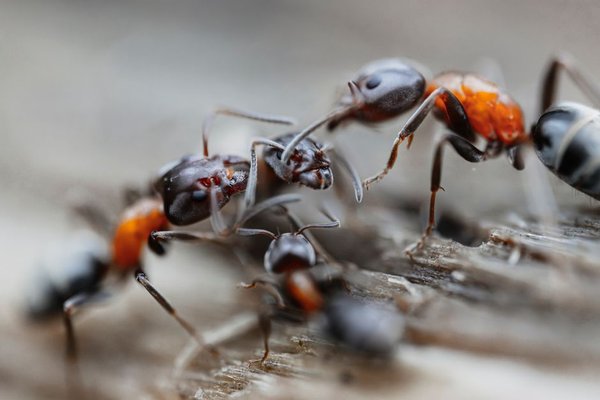
Two ants meeting head-on may briefly tap or sweep each other with their antennae. This behaviour, called antennation, can provide close-range chemical and tactile information. Touch can help workers assess the individual they have encountered and coordinate interactions inside crowded nest passages.
Contact is especially useful where a long-distance scent trail would be too vague. An ant can investigate another worker directly rather than relying only on chemicals left behind on a surface. The exchange may be brief, but repeated encounters help maintain an organised social environment.
Food Sharing Carries Information Too
In species that share liquid food mouth-to-mouth, the process is called trophallaxis. It distributes nourishment, but the exchanged fluid can also carry chemical information relevant to the colony. Not every ant species relies on this method equally, so it is best understood as one possible communication channel rather than a universal ant habit.
Can Ants Communicate With Sound or Vibration?
Yes, although chemical signals dominate many familiar examples. Certain ants produce vibrations or sounds by rubbing specialised body parts together, a process called stridulation. Other ants can detect vibrations through their legs and bodies. Depending on the species, mechanical signals may be associated with disturbance, recruitment or interactions within the nest.
These are not conversations in the human sense. Scientists examine how receivers actually respond before assigning a function to a sound. A noise produced during danger, for instance, is not automatically proof that nestmates use it as a warning.
How Small Signals Organise a Whole Colony
An ant colony does not need every worker to know the entire plan. Workers respond to information available nearby: the strength of a trail, a nestmate’s chemical profile, contact with another ant or conditions inside the nest. Many such decisions combine into activities that look surprisingly coordinated.
Consider nest maintenance. Changes in the environment and interactions among workers can shift attention toward moving brood, cleaning or defending entrances. No single pheromone explains every task. The structure of ant colonies emerges from worker roles, local feedback and multiple channels of information working together.
A Simple Way to Observe Ant Signals
Find a naturally occurring ant trail outdoors and watch without disturbing the nest. Notice what happens when two workers meet, whether they touch antennae and how consistently others follow the same route. If the trail bends around a pebble or crack, look for ants exploring alternate paths before traffic settles.
Avoid spraying chemicals, crushing ants or placing obstacles in their path just to provoke a reaction. Patient observation gives a clearer picture of ordinary ant signals. Different species and situations produce different results, so one trail cannot represent all ants.
Frequently Asked Questions
Do ants talk to each other?
Not with words. Ants exchange information through pheromones, contact and, in some species, vibrations. These signals influence how other ants behave.
How do ants tell other ants where food is?
Many species use chemical trails to recruit nestmates toward food. Others also depend heavily on individual navigation or direct recruitment, so the method differs across species.
Why do ants touch antennae?
Antenna contact helps ants gather chemical and tactile cues at close range, including information useful for recognising nestmates.
Can ants communicate without pheromones?
Yes. Touch, body movements and mechanical vibrations can contribute, although chemical information remains especially important in many ant societies.
Conclusion
Understanding how ants communicate makes their apparent teamwork less mysterious and more impressive. Trails guide foragers, alarm chemicals alter responses to threats, and close contact helps workers recognise and interact with one another. The secret is not a central commander but countless small signals that let a colony respond as a connected, adaptable society.